


It’s a Thursday in Toronto, and the downpour is relentless. Squall warnings flash across the weather apps. Pedestrians cloaked in rain gear are running for cover.
But on Elizabeth Street, a ray of light shines.
Welcome to the Hospital for Sick Children, more popularly known as SickKids, and most recently recognized as the top pediatric hospital in the world.
For the third time since Newsweek began publishing its ranking of World’s Best Specialized Hospitals for pediatrics, SickKids was recognized as the No. 1 children’s hospital—reclaiming the title after three years as runner-up. The Toronto hospital topped the list in 2021 and 2022.
Since becoming Canada’s first children’s hospital in 1875, SickKids has emerged as the country’s most research-intensive hospital and falls among the top three in the world. The hospital has spent the last 150 years making major scientific breakthroughs, including the discoveries of cancer stem cells and the genetic cause of cystic fibrosis.
Today, SickKids performs more than half the pediatric transplants in Canada, including 75 percent of the nation’s liver transplants, 60 percent of heart transplants and more than 50 percent of bone marrow transplants.
“[Leading the ranking] is an incredibly humbling experience,” SickKids President and CEO Dr. Ronald Cohn tells Newsweek. “It speaks to the dedication of every single person who works here at SickKids.”
There are more than three dozen clinical departments at SickKids, but they all work toward a common approach, Precision Child Health. Cohn describes Precision Child Health as taking every data point “from the genetic code to the postal and ZIP code” to understand why each individual child is sick.
During an early September tour of the facilities, the hospital’s soft-spoken leader disappears into the background. Cohn listens intently, chiming in every so often to throw softball questions that set his team up to shine.
In the Simulation Center, he’ll ask what’s wrong with Gwen, a patient doll built with such a high degree of realism that many mistake her for a real-life child with Down syndrome. Her chest rises and falls. Her pulse is tangible through her silicone skin.
The room next to Gwen is what Dr. Lennox Huang, SickKids’ chief medical officer and vice president of education medical and academic affairs, refers to as the “air traffic control center for simulation.” Here, SickKids teams can review audio and video recordings of their performance, identifying areas of improvement for the real thing.
Huang, who describes himself as “a little bit of a geek,” excitedly leads the tour to its next stop: the hospital’s very own Star Trek-style holodeck. Because SickKids has a global footprint that includes work in 27 countries, Huang believes it’s important to simulate scenarios beyond hospital walls.
The immersive room can simulate everything from a choose-your-own-adventure medical crisis to the exact bedroom a kid will return to after their hospital visit. Its interactive projections can show what a child experiences when entering the tube of an MRI machine or enable practitioners to find hazards in their patients’ homes.
“You’re only hindered by your imagination in this space, and I think we’ve got a pretty good imagination here,” Huang says, grinning.
The tour heads over the bridge that joins the hospital’s research center with its clinical space. On the other side, Dr. Devin Singh is waiting just outside the emergency department.

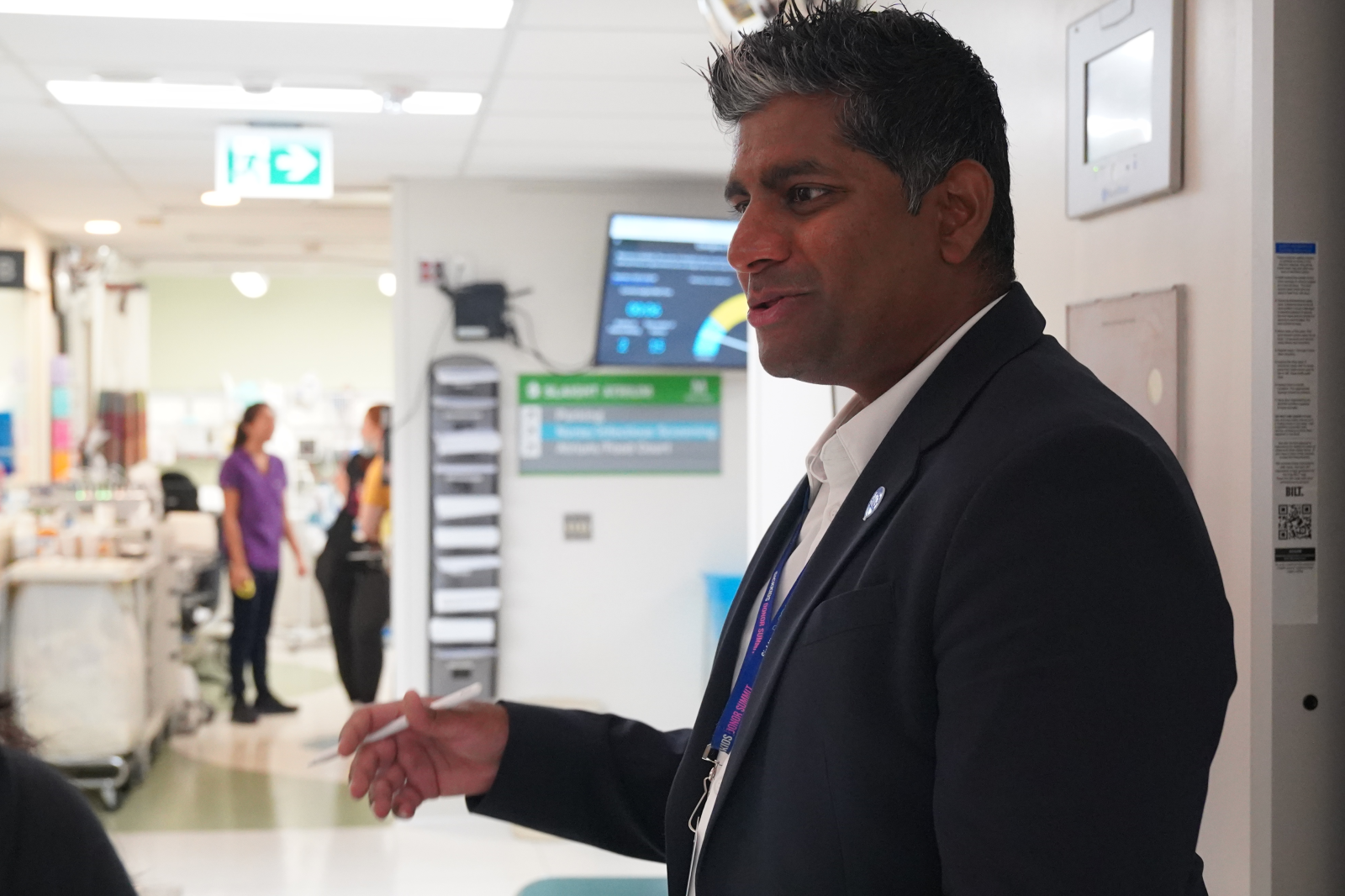
In the division of pediatric emergency medicine, Singh, who serves as the clinical artificial intelligence and machine learning lead, has been working to develop smart solutions that ensure kids are seen quicker. Families already can access ER wait times from their own devices, and within days of this early September tour, SickKids’ new dashboard, which predicts departmental surge times, will be live.
“There are simple ways that we can alleviate that anxiety, and one of those ways is giving families a bit of an expectation,” Singh tells Newsweek.
Singh is also searching for a way to leverage triage data so that lab testing and imaging can be ordered sooner. Based on a patient’s vital signs, hospital staff can often predict cases of appendicitis or urinary tract infections, meaning they can usually determine whether an ultrasound or urine sample needs to be ordered.
“A urine sample sounds a little trivial but try to convince a 3-year-old to pee into a cup,” Singh says. “It’s a song and dance. Being proactive about that is really helpful.”
Getting those tests done earlier means the patient gets a diagnosis faster, and ultimately, can get to surgery quicker.
The tour then moves away from the “fancy AI stuff” and toward Cohn’s favorite innovation at SickKids: the Connected Care program. The program seeks to ease the transition from hospital to home by providing families with educational sessions, learning assessments and real-life practice.
“[Connected Care] has created such a tremendous difference in sending kids home,” Cohn says. “It’s a beautiful example of low-tech, high-impact innovation.”
For families who have watched their children spend hundreds of days in the hospital, going home is both exciting and daunting. Krista Keilty—who has spent the last seven of her 36 years at SickKids as the associate chief of interprofessional practice for Connected Care and system integration—helps lead the team of nurses who seek to bolster confidence in families.
Her team runs dress rehearsals at the child’s bedside, offering parents a kind of safety net as they practice reconnecting tubes or administering other treatments. Those resources continue to be available 24/7 after discharge.
“We provide that kind of support so that children can go to school, they can go to summer camp, they can go visit their grandmother, whatever those key transitions might be,” Keilty says.

The final stop of the tour is perhaps where you’ll find the biggest smiles at SickKids.
In Marnie’s Lounge, there’s an enormous pool table, a video game system and a bracelet beading station. (“A lot of friendships have been made here,” Cohn whispers.) There’s also a kitchen, which Shaindy Alexander, SickKids’ clinical manager for child life and certified child life specialist, attributes to helping at least one patient feel more comfortable.
A few years ago, a teenager at the hospital stopped eating, sparking concerns that he might be depressed. After speaking with him, Alexander realized that he simply didn’t like the food he was offered.
“Nothing tasted like home for him,” Alexander tells Newsweek. “He, his mom and I came, and we cooked this okra dish together. He ate the whole bowl.”
She moves the tour to Marnie’s Studio, the set from which SickKids broadcasts its live shows. Recognizing that some kids can’t leave their beds, the closed-circuit television channel offers patients the chance to participate from the comfort of their rooms. Kids can call in to interact with the on-screen guests, including actor Ryan Reynolds, Toronto Maple Leafs captain Auston Matthews and singer Shawn Mendes, all of whom have paid a visit to the hospital.
Helping to reimagine the patient experience at SickKids is Karen Kinnear, SickKids’ vice president of clinical operations and patient and family experience.
“[During the pandemic],’ we were always in masks. We were always in PPE. There was so much disconnection. So, it was about bringing people together,” Kinnear tells Newsweek. “Historically, we’ve heard from our families that we put them on a committee, but don’t listen to their voice. We ask their opinion, but don’t enact anything. So, we really wanted to have a strategy that was about authentic engagement.”
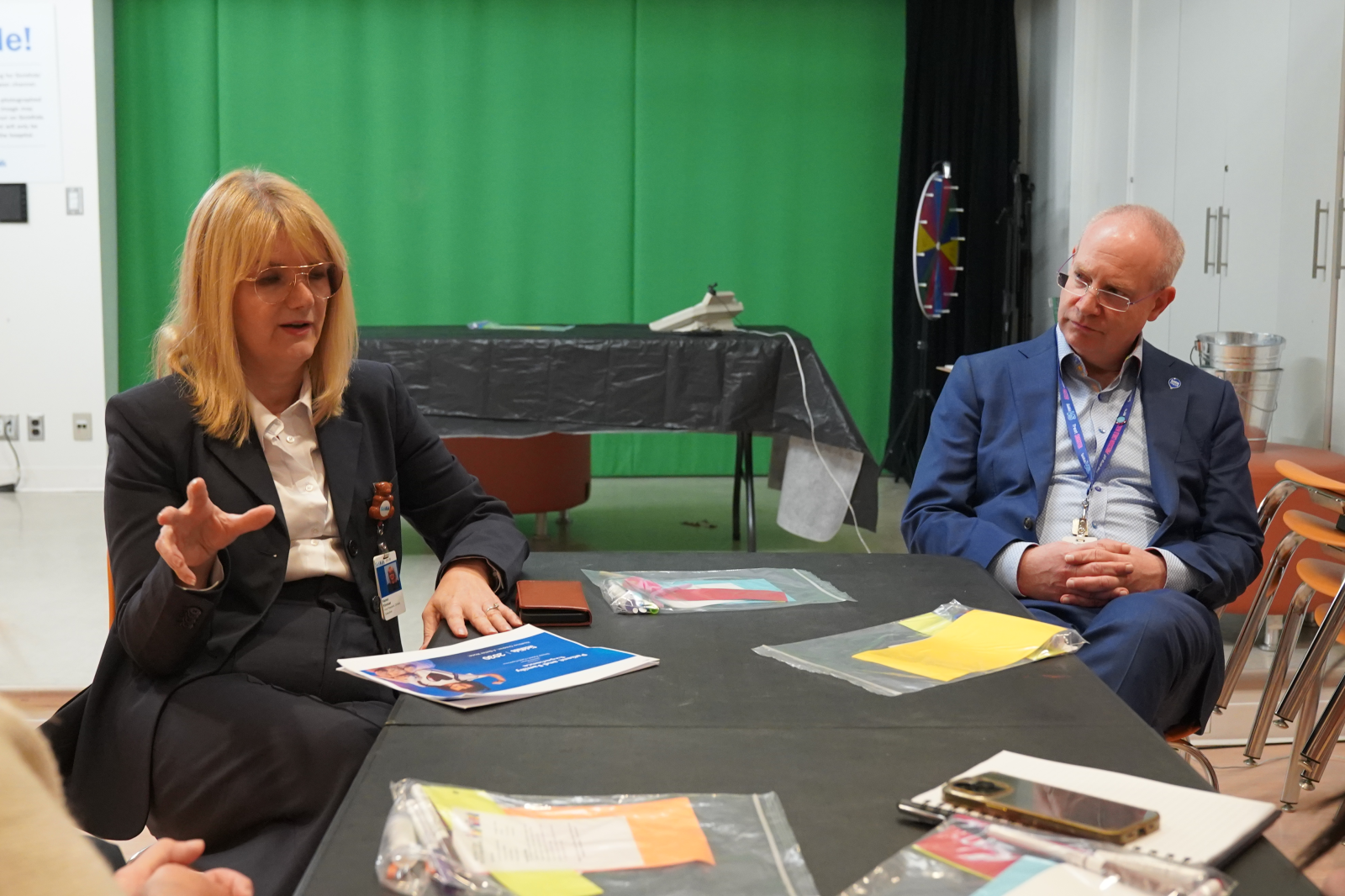
To do so, Kinnear formed a team of consultants to create processes that measure the impact that families have on decision-making. What makes SickKids unique, according to Kinnear, is that the culture of listening extends to hospital staff.
A few years ago, Cohn embarked on a journey to bring “Rounds with Ronni” to SickKids. The rounds, which the CEO conducts a few times a week, give physicians, nurses and everyone in between the chance to tell Cohn what they’re seeing on the hospital floors. Having done more than 180 rounds, Cohn calls it “one of the best decisions” he’s made.
“Sometimes, just sitting in front of people and acknowledging that, ‘This is hard. I’m frustrated too,’ goes a long way,” he says.
Cohn said that it’s “cheesy,” but for him, SickKids is about the people.
“Everybody is so proud to work here. We have an honest, respectful, transparent exchange of ideas,” Cohn says, smiling. “I hope you got a little bit of that feeling today”
link